
Tennessee
SWPPP Permitting
…in Nashville, Clarksville, Chattanooga, Memphis
Simple up front pricing
72 hour turnaround time
Custom plans for projects in Tennessee
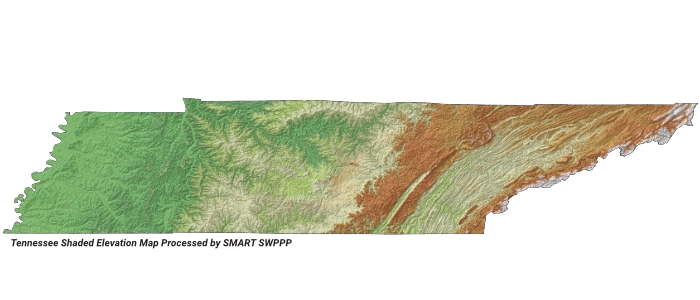
Have a project in Tennessee?
Our Tennessee SWPPP permitting services are designed to get your project started and ensure compliance with state and local SWPPP requirements. A Stormwater Pollution Prevention Plan, also known as a SWPPP, SWP3, or SW3P, is a site-specific document that identifies:
- – The scope of the project
- – The operator(s) responsible for implementing the Stormwater Pollution Prevention Plan
- – Potential sources of stormwater pollution at the construction site
- – The measures that will be implemented to contain on-site pollutants and prevent them from being carried off-site in the form of runoff during storms.
How to obtain permit coverage in Tennessee
The Tennessee Department of Environment and Conservation (TDEC) General Permit TNR100000 allows general contractors, developers, and home builders to discharge stormwater into state waterways, provided they comply with the terms of the permit. The first requirement for contractors and developers is to develop a Stormwater Pollution Prevention Plan (SWPPP). The second requirement is to obtain permit coverage. There are two paths to obtaining coverage under the Tennnessee General Permit TNR100000.
| Option 1 | Option 2 | |
|---|---|---|
| Single family residential homebuilding sites with no significant grading | Projects disturbing 1 or more acres, or that are part of a larger common plan of development | |
| Requirements | Requirements | |
| 1. Complete the CN-1249 Form | 1. Develop a Stormwater Pollution Prevention Plan | |
| 2. Submit your Notice of Intent and CN-1249 through the MyTDEC Forms portal 30 days prior to commencing construction | 2. Submit your Notice of Intent and SWPPP through the MyTDEC Forms portal 30 days prior to commencing construction | |
| 3. Pay the NOI Permit Application Fee | 3. Pay the NOI Permit Application Fee | |
| TDEC NOI Application Fees | ||
|
||
The TDEC NOI application fee is based on the total acreage planned to be disturbed by an entire construction project for which the applicant is requesting coverage, including any associated construction support activities (e.g., equipment staging yards, material storage areas, excavated material disposal areas, borrow or waste sites).
How can Smart SWPPP help?
Smart SWPPP offers a streamlined approach to getting your SWPPP developed and notices submitted within 72 hours. We also offer a wide range of other services to meet your compliance needs in Tennessee. Let us help you save time and resources on your next project.
Getting started is easy
2
Fill out the project information form and upload your plans
After submitting your order, you’ll receive an email to upload your plans
3
48 to 72 hours later, you’ll receive your SWPPP
Need it faster? Please contact us; we’re here to help you get your project started.
Residential Stormwater Pollution Prevention Plan
$499
Includes
Prepared CN-1249 SWPPP Template
Prepared TDEC TNR100000 Notice of Intent application
72 hour turnaround time
Stormwater Pollution Prevention Plan
$799
Includes
Prepared TDEC TNR100000 Notice of Intent application
Prepared TDEC Construction Site Notices
72 hour turnaround time
TDEC Notice of Intent
Prepared permit application
$99
Ideal for
Projects that have a SWPPP but need their TDEC TNR100000 Permit
Includes
Sign and complete all documents electronically
48 hour turnaround time
Need a custom solution for your project?
Call 1-888-363-0022
Ideal for
Developers and home builders with multiple projects
Multi-phased developments
Residential Stormwater Pollution Prevention Plan
Stormwater Pollution Prevention Plan
TDEC Notice of Intent
Prepared permit application
Need a custom solution for your project?
$499
$799
$99
Call 1-888-363-0022
Includes
Prepared CN-1249 SWPPP Template
Includes
Prepared TDEC TNR100000 Notice of Intent application
Ideal for
Projects that have a SWPPP but need their TDEC TNR100000 Permit
Ideal for
Developers and home builders with multiple projects
Prepared TDEC TNR100000 Notice of Intent application
72 hour turnaround time
Prepared TDEC Construction Site Notices
72 hour turnaround time
Includes
Prepared TDEC Construction Site Notices
48 hour turnaround time
and
Multi-phased developments
Frequently Asked Questions for Tennessee
- – in separate stages
- – in separate phases
- – in combination with other construction activities
- – plats
- – blueprints
- – marketing plans
- – contracts
- – building permits
- – public notice or hearing
- – zoning requests
It can include one operator or many operators.
Example: A subdivision is being developed. You are building homes on 2 acres, another company is clearing 3 acres in the next phase, and a contractor is excavating another 0.5 acres for a pond. In this case, the total area that would be disturbed is 5.5 acres. As a result, each operator would be subject to the requirements associated with disturbing 5 or more acres.
“Construction” refers to actions that result in a disturbance of the land, including clearing, grading, excavating, and other similar activities.
It also includes “construction-related activities,” areas that support the construction project such as stockpiles, borrow areas, concrete truck washouts, fueling areas, material storage areas and equipment storage areas. Construction activities that do not disturb land, such as interior remodeling, generally do not require LPDES or NPDES permit coverage.